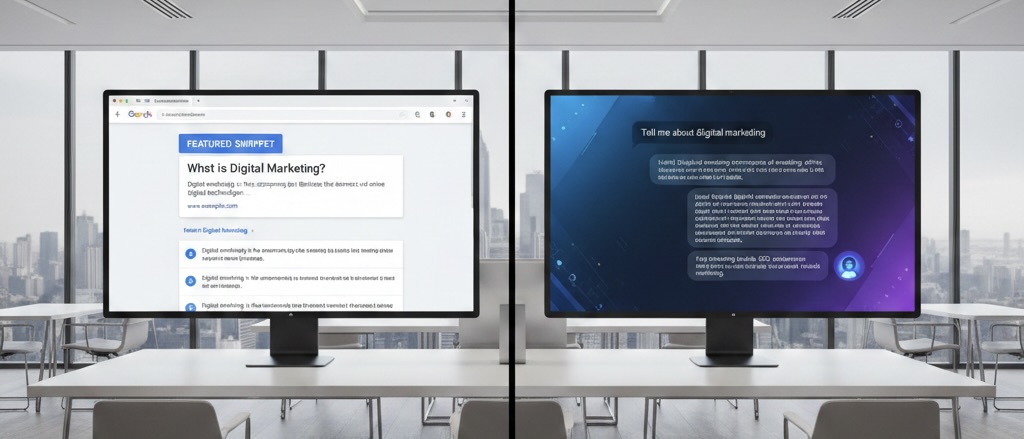
Featured snippets and AI answer engines both deliver instant answers, but they work differently. Google extracts a concise answer from a single webpage for featured snippets. In contrast, AI answer engines synthesize information from multiple sources to provide conversational, context-aware responses—often without requiring users to click.
In short, featured snippets enhance search results, while AI answer engines transform how users discover and consume answers.
Why This Comparison Matters in 2025 and Beyond
Search behavior evolves rapidly. Users no longer type short keywords; they ask full questions, speak naturally, and expect immediate clarity. Marketers must understand how to earn visibility in both environments.
Ignoring this shift means content can still rank—but users may never see it.
What Are Featured Snippets?
Featured snippets appear at the top of Google’s search results, often called “Position Zero.”
How Featured Snippets Work
Google:
- Identifies a clear question-based query
- Extracts a short, relevant passage from one webpage
- Displays it prominently above organic results
Common Types of Featured Snippets
- Paragraph snippets (definitions, explanations)
- List snippets (steps, tips)
- Table snippets (comparisons, pricing)
- Video snippets (how-to guides)
Why Featured Snippets Matter for SEO
- Increase visibility
- Build authority
- Drive higher click-through rates
They still rely on traditional ranking signals like backlinks, relevance, and page authority.
What Are AI Answer Engines?
AI answer engines generate conversational answers by analyzing multiple sources. Examples include:
- Google AI Overviews
- Bing Copilot
- ChatGPT Search
- Voice assistants like Alexa and Siri
How AI Answer Engines Work
AI systems:
- Analyze multiple authoritative sources
- Understand context and intent
- Generate original, synthesized responses
- Cite sources selectively
Key Characteristics of AI Answer Engines
- Conversational responses
- Context-aware follow-ups
- Frequently zero-click
- Solve tasks, not just answer questions
Featured Snippets vs AI Answer Engines: Core Differences
The table below highlights the fundamental distinctions between these two answer formats to help marketers understand where strategies must diverge.
| Feature | Featured Snippets | AI Answer Engines |
|---|---|---|
| Source | Single webpage | Multiple sources |
| Output style | Extracted text | Generated response |
| Interaction | One-off answer | Conversational |
| Click dependency | Often drives clicks | Frequently zero-click |
| Optimization focus | SEO | AEO (Answer Engine Optimization) |
| Content format | Short, direct | Contextual, layered |
How User Behavior Differs Between the Two
Understanding intent helps marketers optimize content effectively.
Featured Snippet User Intent
- Seek quick facts
- Likely click for more detail
- Accept brief, static answers
AI Answer Engine User Intent
- Seek explanation, comparison, or guidance
- May ask follow-up questions
- Often complete the journey without clicking
This shift shows that search has moved from navigation to resolution.
Optimization Strategies: SEO vs AEO
While SEO remains essential, AEO requires a more structured, intent-driven approach.
Optimizing for Featured Snippets
- Use clear H2/H3 question headers
- Provide concise answers (40–60 words)
- Use bullet points and tables
- Ensure strong on-page SEO
Optimizing for AI Answer Engines
- Answer questions comprehensively
- Use natural language and conversational tone
- Structure content semantically
- Address multiple intents in one article
- Build topical authority, not just keywords
Content Structure That Wins in Both Systems
The most effective strategy is dual optimization.
High-Performing Content Traits
- Clear definitions early
- Logical information flow
- FAQ sections
- Consistent entity usage
- Explicit answers followed by context
This allows:
- Featured snippets to extract clean answers
- AI engines to synthesize richer explanations
Measurement: How Success Is Different
Traditional SEO metrics alone no longer capture full visibility.
Before the table below, it’s important to understand that featured snippets and AI engines reward influence differently, which affects how success should be measured.
| Metric | Featured Snippets | AI Answer Engines |
|---|---|---|
| Click-through rate | Important | Often irrelevant |
| Impressions | Moderate value | High value |
| Brand mentions | Limited | Critical |
| Authority signals | Backlinks | Expertise & clarity |
| Zero-click impact | Low | High |
In an AEO world, being cited or referenced is often more valuable than being clicked.
Common Questions Marketers Ask (FAQ)
1. Are featured snippets becoming obsolete?
No—but they are no longer the pinnacle of visibility. They coexist with AI answers.
2. Is SEO still relevant?
Yes. SEO forms the foundation. AEO builds on top of it.
3. Can one article rank for both?
Absolutely. Well-structured, intent-driven content can power both formats.
4. Do AI answers replace websites?
Not entirely—but they reduce dependency on clicks, especially for informational queries.
Strategic Implications for Brands and SMEs
This shift levels the playing field. Large brands once dominated visibility through backlinks and budgets. Today, clarity, usefulness, and expertise determine which content AI systems trust.
SMEs can now:
- Own niche topics
- Build authority through structured content
- Compete without heavy ad spend
A Strategic Shift in How Answers Are Won
Featured snippets marked the beginning of instant answers. AI answer engines represent the next evolution—where answers are no longer extracted, but constructed.
For digital marketers, the goal is no longer just ranking higher—it’s being referenced, trusted, and reused by AI systems that shape user decisions. Brands that adapt now will not only survive declining clicks but thrive through visibility without friction. In this new era, success belongs to those who understand that the best content doesn’t chase traffic—it becomes the answer.